
A homeowner has just watched a new roof go on their house. Or the AC is running cleanly for the first time in years. Or the shower they wanted for three years is finally finished.
In that moment, standing in their driveway and looking at work that is clearly done right, they are more likely to leave a five-star review than they will ever be again.
But for some reason, most businesses send them an email the next day.
Why timing matters for review requests
The window of peak satisfaction after a completed job is measured in hours, not days.
By the next morning, the homeowner has moved on to other things. The enthusiasm that would have produced an immediate, detailed review becomes a brief one at best, or nothing at all, because the request never felt urgent enough to act on.
According to BrightLocal’s Local Consumer Review Survey 2024, 88% of consumers are more likely to use businesses that respond to all their reviews. But first, the review has to exist.
Most businesses lose the opportunity not in the response, but in the request, specifically when and how they make it.
On-the-spot review request
The standard process in most home service businesses looks like this: the job ends, the crew leaves, and the office sends a follow-up email the next morning with a review link.
That email competes with everything else in the homeowner’s inbox. It arrives after the excitement of the completed project has cooled, and it gets opened at a rate that reflects that timing.
The alternative requires no follow-up system and no email.
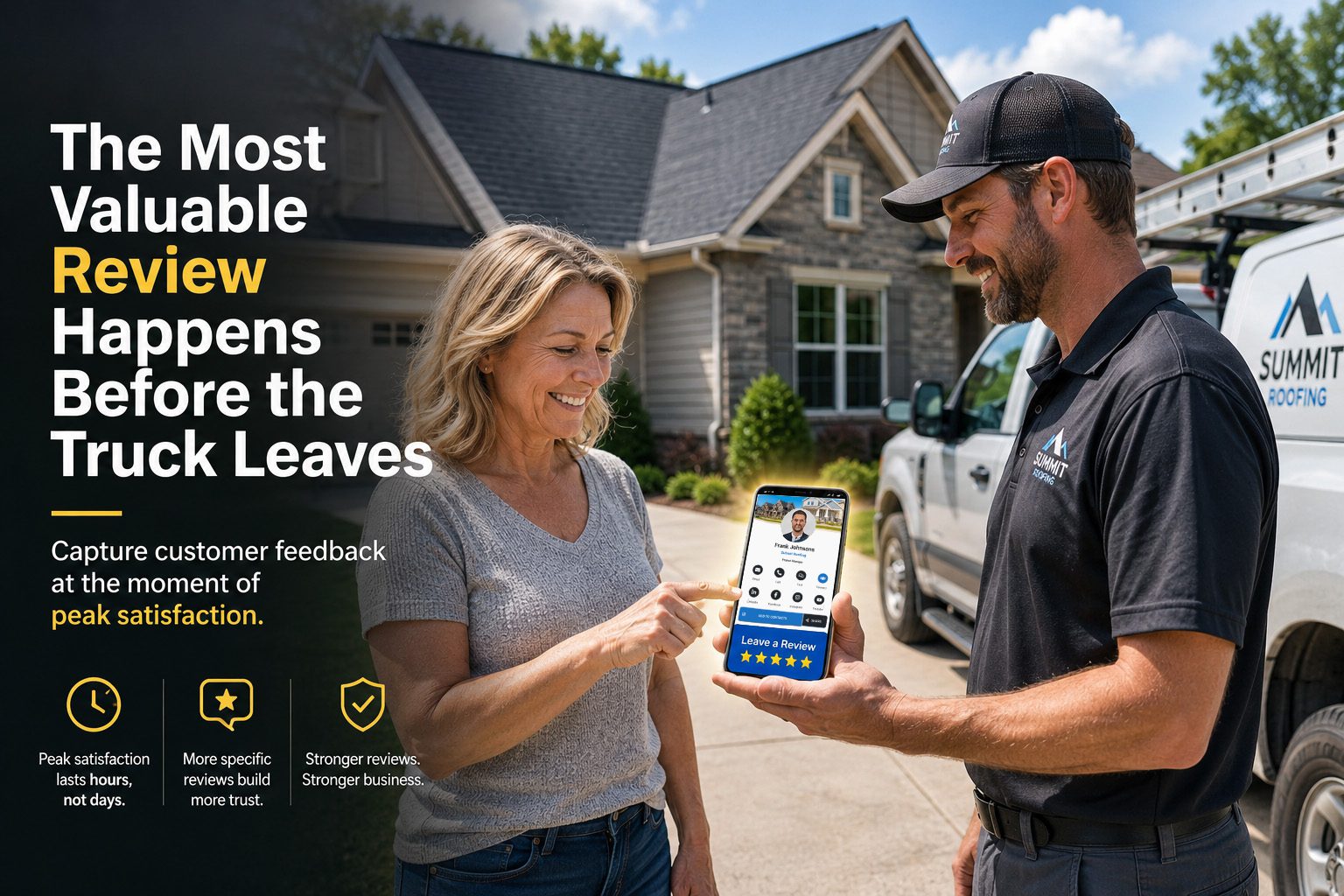
Before leaving the job site, while the homeowner is still standing in front of the completed work at peak enthusiasm, the technician or project manager opens their Identity Profile and walks them through leaving a Google review on the spot. The homeowner posts their feedback before the conversation even ends. The truck has not left the driveway yet.
That is often the difference between a business that collects two or three reviews a month and one that collects two or three reviews a week: the same number of jobs, the same quality of work, and a different process at the end of each one.
What that review does next
A review left at peak satisfaction tends to be more specific and more useful than one written from memory a day later.
The homeowner remembers the details. They describe the work, mention the technician by name, and talk about the experience while it is still fresh. That specificity is what makes a review persuasive to the next homeowner reading it.
Every review captured at the job site becomes a permanent trust signal for future customers. The review does not expire. A job completed in March is still building credibility in September for a homeowner in the same neighborhood deciding which roofing company to call.
Make review requests part of every job
In most trades businesses, the review request depends on the individual. Some technicians do it naturally. Most do not, not because they do not care, but because there is no standard process and no tool that makes it easy.
When every field rep carries an Identity Profile with a configured Leave a Review button, the request becomes part of how a job is completed rather than something that happens later in follow-up. The result no longer depends on who handled the project that day.
There is a good chance the homeowner has already interacted with your OneTapConnect Identity Profile earlier in the project, whether through you or another member of your team. That familiarity removes friction because they already know how to access and use the profile.
Instead of asking them to search for an email or respond later, you can simply share your Identity Profile and direct them to the review button while you are still on-site. It is one of the easiest and most effective ways to capture reviews at the moment of peak satisfaction.
The best time to ask is before you leave
The quality of your work earns the review. The timing of your request determines whether you receive it.
By making review requests part of your job completion process instead of your follow-up process, you can capture more reviews, collect more detailed customer feedback, and build trust with future homeowners.
The best time to ask is not tomorrow morning.
It is before the truck leaves the driveway.
The tutorial below shows how your team can make review requests a standard part of closing every job before leaving the property:
How To Get More Google Reviews Using Your OneTapConnect Identity Profile
Sources: Local Consumer Review Survey 2024, BrightLocal – Feature reference: How To Get More Google Reviews Using Your OneTapConnect Identity Profile