
Data-driven funnel optimization is now standard practice across B2B revenue teams. Organizations track opportunities, deal values, win rates, and pipeline velocity. They build models, run experiments, and make decisions grounded in numbers.
One of the more recognized frameworks in B2B sales operations is the Sales Velocity equation:
Sales Velocity = (Opportunities × Average Deal Value × Win Rate) / Sales Cycle Length
It measures how quickly revenue moves through the pipeline. Each variable is meaningful: more opportunities, higher deal values, a better win rate, and a shorter sales cycle all increase velocity. It is a useful model precisely because it isolates the levers that drive revenue throughput.
There is, however, a variable this equation does not surface. One that sits upstream of Win Rate and influences its outcome before a single qualifying question is asked.
What Win Rate Actually Contains
Win Rate is often treated as a single number. In practice, it is a chain of three distinct events:
Win Rate = Contact Rate × Appointment Rate × Close Rate
- Contact Rate: Did the team successfully connect with the lead after initial interest?
- Appointment Rate: Did the lead agree to a meaningful conversation?
- Close Rate: Did they buy?
Each stage is a discrete outcome with its own drivers. Extensive sales methodology has been built around the third: closing frameworks, negotiation training, proposal structure, objection handling. Far less systematic attention has been paid to the first two.
Contact rate and appointment rate are direct functions of one thing: how the first impression lands. A lead who reaches a real conversation is already predisposed to continue. The critical variable is what earns that conversation in the first place.
Introducing the Trust Multiplier
The Sales Velocity equation accounts for volume, deal value, win rate, and cycle length. What it does not account for is the quality and consistency of the first interaction, the moment where a buyer decides whether to continue or disengage.
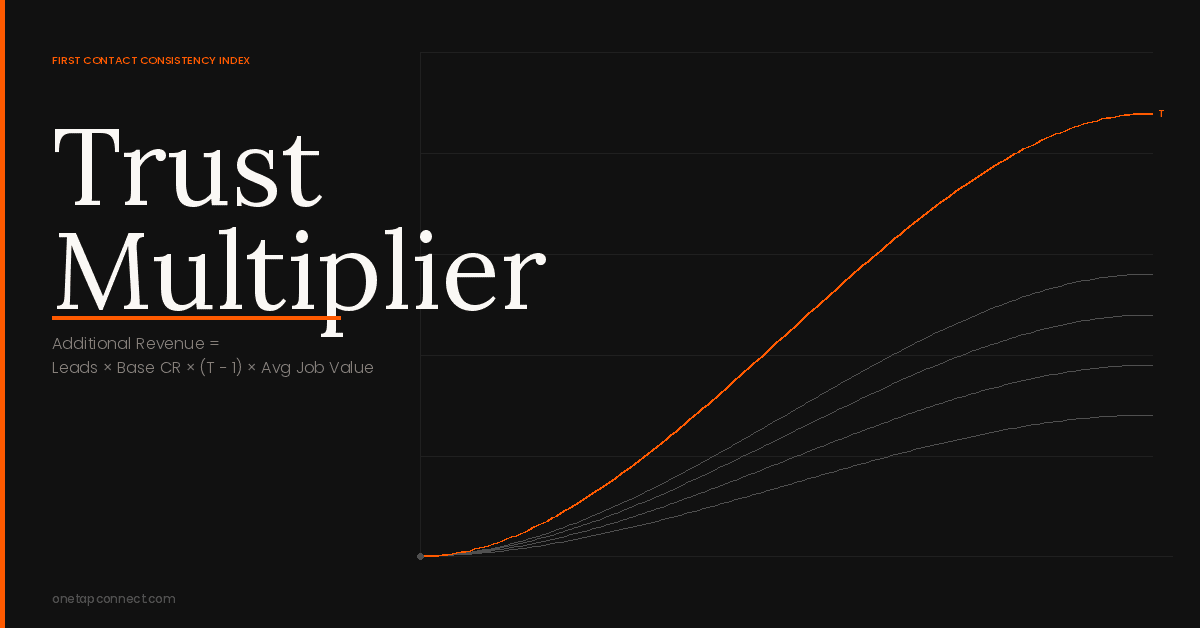
That variable sits directly upstream of Win Rate. It can be expressed as T, the Trust Multiplier.
Within the Sales Velocity framework, Win Rate becomes:
Win Rate = Base Win Rate × T
Where T represents the degree to which first-contact credibility is established consistently across the team. A T of 1.00 reflects the baseline: no structural advantage, no structural disadvantage. Values above 1.00 reflect improvements in first-contact consistency. The magnitude varies by organization, team size, and existing baseline. The direction is constant: as T increases, Win Rate increases, without any change to opportunity volume or closing technique.
To translate that into a concrete revenue impact, the calculation simplifies to:
Additional Revenue = Opportunities × Base Win Rate × (T − 1) × Average Deal Value
An illustration: a company with 1,000 opportunities per year, a 30% base win rate, and a $5,000 average deal value that improves T by 0.15 generates:
1,000 × 0.30 × 0.15 × $5,000 = $225,000 in additional annual revenue
That outcome is produced entirely upstream of the pitch.
Run the calculation with your own numbers using the FCCI Revenue Calculator.
Why the Variable Goes Uncaptured
The reason T does not appear in the Sales Velocity equation, or most revenue planning models, is that first-contact consistency has historically been treated as a people problem, not a systems problem. It sits outside the CRM. There is no pipeline field for “how uniformly did the team establish credibility in the first interaction.” The effects accumulate over time: in the gap between contact rate and appointment rate, in the performance delta between senior and junior reps, in the territory that underperforms despite identical lead quality.
Rep-to-rep variance at first contact is measurable. It shows up in pipeline data. Building a model around it, however, requires naming the variable first.
Naming It: The First Contact Consistency Index
At OneTapConnect, we developed the First Contact Consistency Index (FCCI) as a working framework for measuring this consistency across revenue teams. The goal was to give organizations a way to connect first-contact quality, something that has always existed as a variable, to the revenue model where its impact becomes legible and actionable.
FCCI is a measure of how uniformly a team establishes trust and credibility at the first interaction, across every rep, every territory, and every channel. It is not a measure of individual performance. It is a measure of organizational consistency at the moment that matters most.
A high FCCI does not mean every rep is identical. It means every rep meets the same standard of credibility, professionalism, and clarity when representing the company for the first time.
Every percentage point increase in FCCI increases the probability that a buyer advances to the next stage, because the buyer’s confidence in the organization is established before the conversation begins.
This shifts the strategic question from “how do we improve close rate?” to “how consistently does our organization establish trust at first contact?” The two questions are related, but they require fundamentally different interventions.
What Moves FCCI
Three factors drive consistent first-contact credibility at the organizational level:
1. Standardized identity. Every rep presents with the same brand quality, the same credentials, the same contact information. There is no variance in how the organization appears when a new face enters a room or joins a call.
2. Immediate credibility signals. Reviews, social proof, video introductions, and company context are available at the moment of first contact, not delivered in a follow-up email days later, when the buyer’s initial impression has already been formed.
3. Systematized execution. Consistency is an infrastructure outcome, not a training outcome. A standard that exists in a document is a suggestion. A standard built into the tools every rep uses is a system.
From Variable to Infrastructure
The companies that build a structural advantage in first contact will do so by treating first-contact consistency as an infrastructure problem with an infrastructure solution.
FCCI is the metric that makes that investment legible. It connects a variable that has always existed, the quality and consistency of the first impression, to the revenue planning model where its impact can be quantified.
OneTapConnect is built to move that number. It is the system that standardizes first-contact credibility across the organization, so that trust at scale becomes a function of systems rather than individuals.
To model the FCCI impact on your own business, use the revenue equation above with your own inputs: Leads × Base Conversion Rate × (T − 1) × Average Job Value. Or use the interactive calculator at onetapconnect.com/fcci-calculator.